
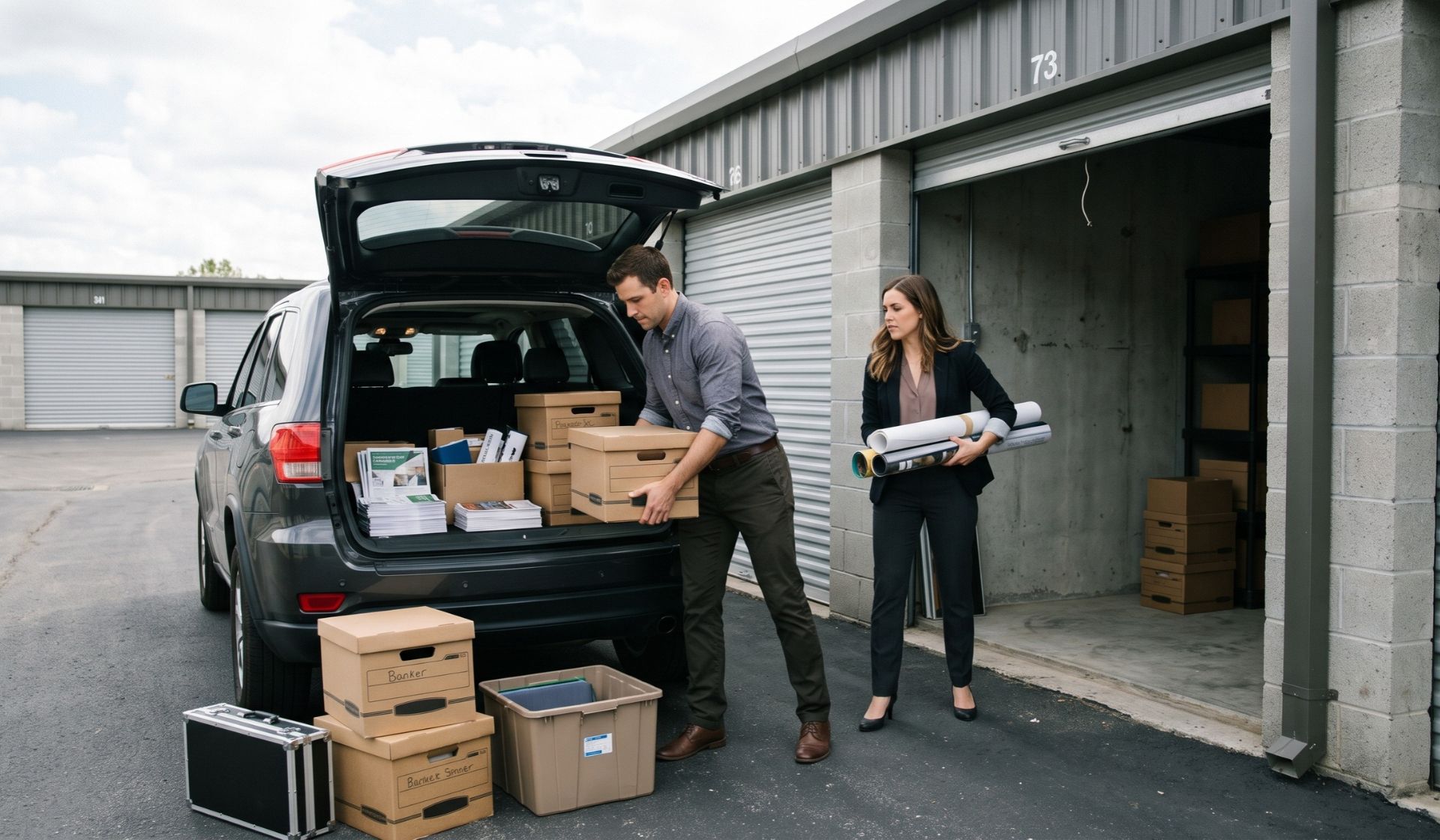
Your sales rep will need brochures and samples for a meeting at 10 a.m., but no one knows where they’re kept. A business storage system would eliminate this chaos. You can create a system where each box contains items relevant to a specific task. Each box should be clearly labeled, and labels should correspond to an inventory.
Explore Central U Storage to learn more about business storage San Jose options.
What Should You Sort Before You Pack?
Sorting your inventory storage can improve label accuracy and reduce storage space. This can also decrease the chances of paying for commercial storage you don't need.
Separate Current Campaigns From Retired Versions
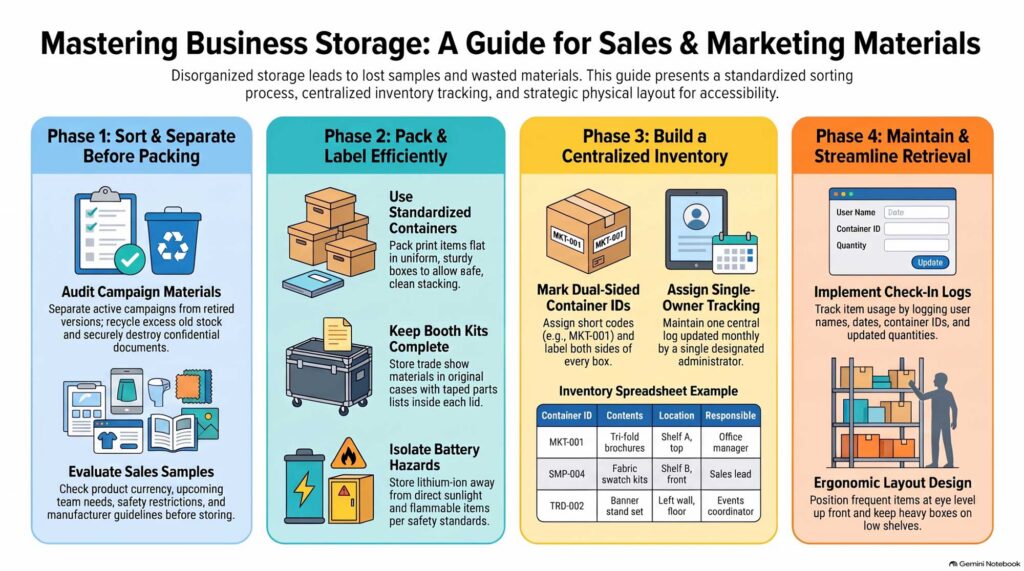
Pull brochures, flyers, banners, and price sheets and group them as current and retired. Keep a few copies of retired marketing materials, and recycle the rest. Securely destroy marketing materials that contain customer information if you no longer need to keep them, following the FTC's guidance on protecting customer information.
Contracts, tax files, and similar records belong in a separate document storage plan. The IRS explains that how long you keep a record depends on the action, expense, or event it documents, so those files follow different rules than marketing materials storage.
Group Sales Samples by Collection or Use
Sort samples by product line, season, or appointment type. Go through the following before packing a sample:
- Is this the latest sample?
- Will your team need this sample in the following months?
- Is there any sensitive or restricted info on this sample?
- Has the manufacturer specified any storage limitations?
- Who should be accountable for the sample?
How Should You Pack Different Materials?
Place samples, displays, and prints in different boxes. Using the same-size boxes makes storage unit organization easier because they stack cleanly.
Pack print pieces flat in sturdy boxes, as you would for document storage.
Trade show material storage works best when each booth kit stays together in its original cases. Tape a parts list inside each lid so no frame or graphic goes missing between events.
Sales sample storage needs the most caution. Follow the manufacturer's guidance for every sample, and remember that not every item belongs in commercial storage. If a display or sample contains lithium-ion batteries, the U.S. Fire Administration advises keeping spare batteries away from anything that can burn and out of direct sunlight.
Ask about rental restrictions before you bring samples into any business storage San Jose facility. When you stack boxes, keep them stable and limited in height, the same principle OSHA applies to workplace storage.
How Do You Build an Inventory Your Team Will Use?
Inventory storage only works when it is organized and makes sense. Make sure to assign a short and simple ID (e.g., MKT-001) to each container and mark it on both sides.
You can connect your label to your shared file with a container ID. Anyone with access to the shared file can find the ID and, in turn, locate the physical label. Below is an example of how an organized business inventory list might appear.
| Container ID | Contents | Campaign/Version | Location | Quantity | Person Responsible |
| MKT-001 | Tri-fold brochures | Spring campaign, v3 | Shelf A, top | 250 | Office manager |
| SMP-004 | Fabric swatch kits | Fall collection | Shelf B, front | 6 kits | Sales lead |
| TRD-002 | Banner stand and graphics | Trade show booth, rev. 2 | Left wall, floor | 1 set | Events coordinator |
| ARC-010 | Retired flyers | Holiday campaign, retired | Back corner | 10 | Marketing manager |
Note: This is a hypothetical example and in no way depicts or is derived from a real-life example.
Store the file in a central location. For improved small business storage, have only one person review and update the file each month. This helps maintain your storage unit organization.
Want to skip manual spreadsheets and handwritten lists? Ask our team how you can upgrade your box labels with ToteScan QR smart labels. Simply stick a label on your container, scan it with your phone to log brochures, samples, or booth parts, and search your entire inventory in seconds, so your sales team always finds what they need before a big meeting.
How Do You Keep Retrieval Simple as Materials Change?
Boxes are less likely to go missing with a check-in/out log. Encourage employees to enter the container ID, the date, and their name when checking items out, and to change the quantity when returning the items.
Update your small business storage unit quarterly. This means disposing of old documents and keeping only the most recent copies. Move older documents to the archive, and get rid of extra copies. Remember to update your inventory storage records to reflect the changes.
Good storage unit organization places frequently used items up front and at eye level. Items that are rarely used can be stored in the back. Pathways should be kept clear. Heavy items should not be stored on higher shelves, as they may create an injury risk when removed.
When evaluating your options for small business storage in San Jose, see which unit size best fits your inventory at Central U Storage. Also, find out what access options are available. Check our contact page for information.
Conveniently Located in San Jose’s Commercial Hub
Even the most organized inventory system slows your team down if your storage facility is out of the way. Located at 1760 Junction Avenue in the heart of San Jose’s commercial and industrial corridor, Central U Storage puts your marketing materials, trade show booths, and sales samples right where your team already travels.
Situated just off East Brokaw Road, our facility offers fast, direct access to Silicon Valley’s major commuter and freight arteries:
-
Interstate 880 (I-880): Just minutes away via the Brokaw Road exit, making it effortless for teams heading north toward Milpitas and Fremont or south toward downtown San Jose and Campbell.
-
U.S. Highway 101 (US-101): Quick connectivity via Brokaw Road puts sales reps on a direct route toward Santa Clara, Sunnyvale, Mountain View, and the Peninsula—or south toward Morgan Hill and Gilroy.
-
Interstate 280 (I-280), Interstate 680 (I-680), and State Route 87 (CA-87): Easy interchange access from US-101 and I-880 connects your team to every corner of the South Bay without navigating congested downtown side streets.
-
San Jose Mineta International Airport (SJC): Located right down the road along the Brokaw/Airport corridor, making it simple for traveling reps to grab last-minute brochures, banner stands, or sample kits on their way to a flight.
With daily gate access, your sales team can swing by off the highway, load up before a 10 a.m. client meeting, and get back on the road without losing valuable selling time.
Questions About Storing Business Marketing Materials
What Belongs on a Box Label?
Provide the container ID and a brief description of contents. For versions and/or dates, also include the corresponding information. Write the container ID in large text and the same format as in your inventory storage file. Use the same format and labels for document storage boxes.
Choose Storage Around How Your Team Works
Team members should spend their time selling, not searching small business storage. Keep track of which inventory items you run out of most frequently, and plan storage unit organization accordingly.
Call Central U Storage at 408-436-8828 to discuss your storage needs, or review the unit sizes and current specials online.
